
Why I'm Catholic
resting in the Deeper Story

I can remember walking to my evening Modern Religious Thought class in a daze.
I had just gotten off the phone with my parents. They had called while I was in dining hall, eating dinner and joking with my friends. I had that premonition people sometimes have when the phone rings. I knew something was wrong the moment it buzzed in my pocket.
My Mom’s voice was strained and odd sounding. I don’t remember exactly how she said it but she told me that her cancer was back and it was not good news. Stage 4. Some timeline was referenced. “Maybe years” was said in a sad imitation of a hopeful voice. The phone was quickly passed off to my Dad for reassurances and then the call was over.
My college was a sort of mystical place. So much of my time there was spent outdoors, in the woods or swimming in the river, in a kayak or in a field under the stars. I always felt a little out of time there, and now especially so, walking to class in the sweet evening air with this new concept of my life ringing in my head. This life where I had a sick parent who would die, not someday, but very soon.
In this class we had been discussing great theologians. We had read Martin Luther King’s Letter from a Birmingham Jail. We had encountered Teilhard de Chardin’s ‘Omega Point’ and Paul Tillich’s ‘Ultimate Concern.’ We had searched Catherine Keller’s faces of the deep and sought Grace in Bonhoeffer’s Letters. We had encountered real despair in the camps and Viktor Frankl’s search for meaning.
I was astounded by this reading. All my books from this class are heavily underlined, encountered in a sort of frenzy. My commonplace notebook overflowed.
I open it now, in spring 2025, to spring 2013:
“The universe seems to be nearer to a great thought than a great machine.” — Martin Luther King Jr., quoting Sir James Jeans, Strength to Love
“We must make a choice. Will we continue to march to the drumbeat of conformity and respectability, or will we, listening to the beat of a more distant drum, move to its echoing sounds?” — Martin Luther King Jr.
“Just as water reflects the face, so one human heart reflects another.” — Proverbs 27.19
“The God who is with us is the God who forsakes us… Christ helps us not by virtue of his omnipotence, but by virtue of his weakness and suffering.” — Dietrich Bonhoeffer
“The human heart seeks the infinite because that is where the finite wants to rest. In the infinite it sees its own fulfillment.” — Paul Tillich
These words echoed in my mind as I watched the river at night, as I walked the fields in Historic St. Mary’s City, as I sat on my favorite bench in the graveyard on the hill. I thought of Bonhoeffer, of King, of these martyrs to ideas. Would I have the strength? What conviction, what ultimate concern, did my life rest on?
I suddenly realized, with an incredible force, that you cannot rest your life on an idea. Ideas change, they merge, they evolve. You would need something greater than that - greater than you - to march to ‘the more distant drums.’
I thought of the men and women in the Holocaust camps. Frankl noticed that the ones who did not despair often believed in God, they believed that their lives had meaning beyond the unfortunate reality of their circumstances. If one’s whole sense of meaning rested on something as fragile as if one lived or died, could one even get up in the morning? Few could.
I thought of my mother and this terrible disease and the vast unfairness of it. But what of it? People did get sick. I could get in a car accident the following day. There were wars raging across oceans, genocides to grapple with. The seeming randomness of suffering, the shifting sand under my feet, had always filled me with a deep, unnameable terror. All that gave my life its peace, its structure, was so incredibly unsure. It could all change in a moment, and it was all out of my control. How could I live with that? How could anyone, if one really took a moment to think about it?
And what I realized, through all these great books, through all those late night walks, was that life was bigger than any given moment of suffering. It was bigger than loss and the existential terror it brings.
I encountered some words by someone who understands these things, who wrote about them very well in her stories, when I read these words of J.K. Rowling’s —
"Love wins. It does win; we know it wins. When the person dies, love isn't turned off like a faucet. It is an amazingly resilient part of us."
I have here in my commonplace book a quote from my professor, Katharina von Kellenbach1, from one of her lectures,
“Arguing for the existence of God is similar to arguing for the existence of Love.”
Let me back up.
This isn’t really a conversion story because my story feels too winding, and too continual, to sum up. But let me explain that I was baptized Methodist in what, from the photos, look like a very lovely ceremony, but that my religious exposure was limited to very occasional church outings on Christmas and Easter.
I had nothing particularly against religion, at least not until I was sixteen and could argue with Christians in AIM message boards and feel morally superior. Atheism always seemed so much smarter, definitely cooler, but I was too much a lover of story to be a true materialist. I had dreams and hopes beyond the scope of this world and they were real to me. I didn’t dismiss them. So perhaps I was more open than most.
Open enough that when my liberal arts college required a humanities credit, I chose Religious Studies on a whim. My first class I was on the edge of my seat. It was about Islam and it featured a woman wearing a hijab and explaining why she did. I was shocked. Religious garb always seemed like a nice way to play dress up, somewhat ridiculous in its way, but her arguments were compelling. As we moved through the world religions, I was an excited anthropologist, fascinated by these earth-shattering ideas that compelled people to act in certain ways, to dress in certain ways, to give a certain structure to their lives. I quickly, and to my parent’s surprise, declared myself a duel Religious Studies/English major.
Religion classes supplemented my literature studies in every way - you cannot read Shakespeare without an understanding of Protestant/Catholic divisions. You will not understand half the references in poetry without the Bible. But I remained a curious onlooker, almost like a colonialist who would observe some native tribe with strange delight and a certain amount of awe. But there was a sense of superiority there, certainly. How fascinating that people can actually think this way!
When I was in my Biblical Foundations class, pouring over the Old Testament like a Torah scholar, my study partner was shocked when I told him I didn’t believe in God. What was I doing in this class, then? I was a historian, I told him, a cultural anthropologist! I told the same to the somewhat amused Hebrew teacher at the synagogue, the rest of the class filled mainly with converts.
But I found the stories in the Bible incredibly beautiful and complex. I found the story of a world Loved into Being to be the most astounding poetry I had ever encountered. And as time went on, I began to believe it was True. I believed it was true the same way I believed in Aslan and in the Return of the King. I believed stories and I will always be grateful for the incredibly beautiful stories that defined my childhood and allowed me to believe in even Truer stories.
I read C.S. Lewis. I had moments of quiet thought at night when I realized I didn’t think I was just talking to myself, that this was more a conversation than a monologue. But who was listening? I still didn’t know. I could tell you about Oxford, about Christ Church meadows, about the beautiful Catholic friends who took me to the Oratory. I could tell you about St. Catherine of Siena, about her Dialogue, and the tangled story of the soul, the thesis I spent a year writing.
But when I think of my faith I think back to that phone call and the books I was reading at the time. Because it was the first time I was compelled to confront the realities in front of me. Death was a fact. Suffering was inevitable. What was I going to do with this information? I could bury those things, in alcohol and experiences, in noise and in fun, but they would find me again someday. Or I could look them in the face, I could ask the question Viktor Frankl asked all his patients, Is Your life still Meaningful?
It would take many more years. My mother would die and I would walk into Anglican churches. I would then leave again, forget about it all. Time passed. I got married. And then fate sped up, and a beautiful Basilica and a convicted priest and soaring chant all merged into one, and I heard a homily, Moving toward God is like the move from a clenched fist to an open hand. I opened my hand.
There was a time I was Catholic because of beautiful chant, candles, stained glass. I was there for the beauty.
There was a time I was Catholic for the intellectual tradition, for the thousands of years of sound argument and the confrontation with life’s biggest questions.
There was a time I was Catholic because of John Paul II’s Theology of the Body talks, when I finally had language for the reality of sexuality, for family, for children, a new-found respect for the female body’s rhythms and this beautiful understanding of life’s origins.
There was a time I was Catholic because I was finally able to intellectually discern why many things that “felt wrong,” simply were wrong, that they diminished and disrespected the inherent and innate dignity of the human person.
There was a time I was Catholic because it gave me language for defending the poor, the refugee, for arguing against children turning into science experiments, for the protection of the elderly, the sick, and the unborn.
This fall2 was seven years since I became Catholic.
Now I am Catholic for all those reasons, but they are not my Ultimate Concern (Tillich’s concept of what truly moves and orients a person’s soul). In the midst of small children, family life, work, and shifting seasons, I no longer have the luxury of hours in Adoration, or two hour long Latin Masses, or time to pour over intellectual reading. I miss those things, they spoke deeply to my nature.
But now I rest in a Deeper Story and a Deeper Truth. I rest in the feeling of my two year old asleep on my chest, or how my four year old strokes my hair at bedtime. I feel deep ease and delight in walking the fields of our farm, or the gentle snuffling of a horse’s nose. I delight in growing things. In flowers. In the seasons.
I do not so much as “think” my faith as live it, radically imperfectly, in a continual hope and reception. I don’t pray as consistently as I should, I make many mistakes, but I do not doubt the deep truths that first started gnawing at my consciousness all those years ago.
And more than that, each and every Sunday, when I receive the Eucharist, I am part of the greatest story of all: This is my Body, Given up for You.
I believe that Life is greater than Death, that Love is not something to be proven, but something to be lived.
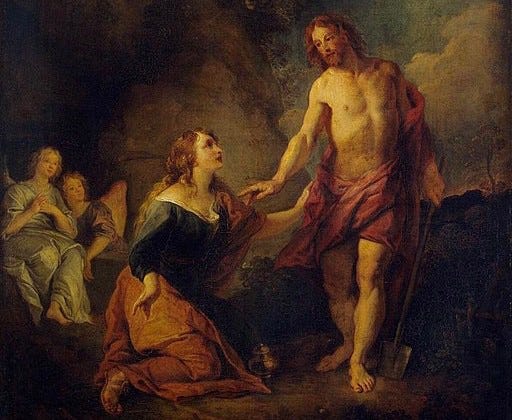
And on this Good Friday, as we approach the saddest and most resplendent of mysteries, in Death and in Resurrection, I will always think of these words of Christ upon descending into Hades, taken from a sermon for Holy Saturday3:
Awake O Sleeper, I did not make you to be Prisoner of the Underworld.
I did not make you to be a prisoner. I made you to be Free. To Love and be Loved.
That is the story I rest my whole life on. And I believe it is True.
Deo Gratias, and a blessed Easter Triduum!
“Joy to the world then we sing
Let the earth receive her King
Joy to the world then we sing
Let the angel voices ring!”
if you’re reading this Katharina, thank you again for your wisdom!!!
I came into the Church on the Feast of Christ the King
Beautiful. Hearing the "C" word spoken over the phone by a family member is so devastating. My mother sounded almost embarrassed when she left me a message about her diagnosis--as if she'd failed in some way.
I used to get so annoyed when my mother would suggest I read the Bible. I wanted her to convert to all the New Age ideas I was ingesting. When I was lying in a hospital bleeding to death, I only turned to Jesus to accuse him. "If you're real then why don't you just heal me right now?"
It's funny that he did end up healing me (the doctors grudgingly said it was a miracle). But I STILL didn't want to go back to Catholicism. I thought I knew all about it in my youthful arrogance.
It took me writing a novel about redemption (and scanning Bible pages for good quotes) for God to drag me back into the fold. A bigger miracle than my physical healing.
This was gorgeous and I recognise so much of it. It’ll be 10 years next Easter since I was received into the Church so I’ve been thinking a lot about my “story” but like you, I can’t say where it begins and it certainly continues. I could point back to things in my childhood, moments when I sort of reached towards a concept of God. I also ended up with a lot of Religious Studies in my university years - my first degree was history but I ended up writing my thesis about Islam in the Central Soviet Republics in the 1920s (and also took a bunch of religious studies credits at another university). I did my first Masters in Religious Studies and it was definitely the high point of all my years as a student in terms of pure delight in my studies. When I did an MA in Media, Campaigning, and Social Change, I wrote about whether Catholics thought responding to climate change was a matter of religious duty. Oh and when I was in high school I got an award for being the first person to ever get 100% on a Religious Studies paper, which was “Can genetically modified embryos ever be morally acceptable to Christians?”
Conversely to you, I didn’t really start to care about story until I had already bought into the Story. But once I did, I couldn’t unsee that every single thing about life is part of that Story.